How OP Labs allocates capital through grants
Optimism’s funding strategy has evolved from a standard grant model into a dual-engine system designed to prioritize public goods and core infrastructure. The ecosystem no longer relies solely on direct applications for project support; instead, it integrates Retroactive Public Goods Funding (RPGF) to reward contributions that have already demonstrated value. This shift ensures that capital flows toward projects that are actively used and maintained, rather than those merely promising future utility.
The primary mechanism for this allocation is the OP Grants program, which operates alongside the broader Retro Funding model. While direct grants target specific development milestones or critical infrastructure gaps—such as tooling for the OP Stack or security audits—RPGF allocates tokens based on historical impact. This approach reduces the risk of funding "ghost towns" by tying financial support to measurable on-chain activity and community adoption.
This strategy aligns with Optimism’s goal of building a sustainable, decentralized ecosystem. By prioritizing infrastructure and verified impact, the OP Grants program aims to create a resilient foundation for DeFi and other applications on the network. The focus remains on concrete data points from official sources like GitHub and Dune to guide these decisions, ensuring that resources are directed where they are most needed.
Top DeFi protocols on Optimism
The Optimism DeFi ecosystem has matured from experimental testbeds to high-throughput financial infrastructure. By 2023, the network had accumulated over $2 billion in onchain value locked, saving users an estimated $3 billion in gas fees compared to Ethereum mainnet. This efficiency has attracted a diverse set of protocols, each specializing in a specific financial function.
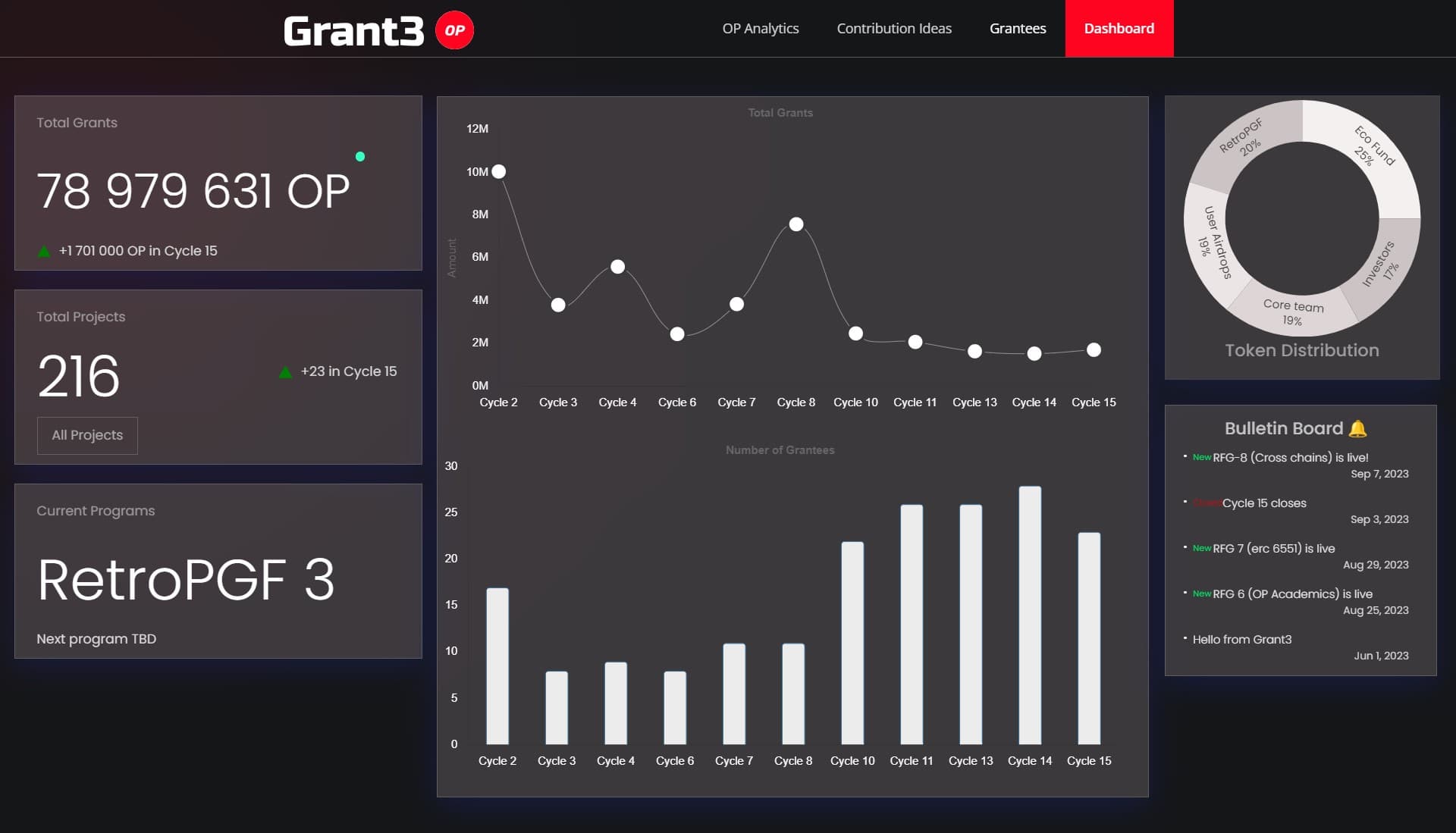
To navigate this landscape, it helps to categorize protocols by their primary utility. The following table compares the four most significant DeFi applications on Optimism, focusing on Total Value Locked (TVL), daily volume, and core function. These metrics reflect the current state of the ecosystem's infrastructure.
| Protocol | TVL (Approx.) | Daily Volume | Primary Utility |
|---|---|---|---|
| Uniswap V3 | $250M+ | $50M+ | Decentralized Exchange |
| Aave V3 | $1.2B+ | $100M+ | Lending & Borrowing |
| Synthetix | $300M+ | $20M+ | Synthetic Assets & Derivatives |
| Velodrome | $150M+ | $15M+ | Concentrated Liquidity AMM |
Uniswap V3 remains the dominant liquidity hub for spot trading, offering concentrated liquidity positions that maximize capital efficiency for traders. Aave V3 serves as the backbone for lending markets, providing deep liquidity for stablecoin and ETH borrowing. Synthetix continues to lead in synthetic assets, allowing users to gain exposure to real-world assets like gold or equities without leaving the chain. Velodrome, an automated market maker (AMM) built on the Velodrome Finance framework, has become a key player in providing low-slippage swaps for newer and volatile tokens.
These protocols do not operate in isolation. They are often interconnected, with liquidity from Uniswap or Aave being used as collateral in Synthetix or Velodrome. This interoperability creates a robust financial stack, but it also increases systemic risk. Users should always verify contract addresses and audit reports before interacting with any of these platforms.
The OP Stack changes how chains are built
The OP Stack is the engine behind Optimism, but its real value lies in its open-source nature. It allows developers to launch their own Layer 2 networks that inherit Optimism’s security model without building everything from scratch. This approach, often called Chain-as-a-Service, has shifted the industry from isolated chains to a shared security ecosystem.
Projects like Base (Coinbase) and Mode have leveraged the OP Stack to deploy high-performance networks. By using a common codebase, these chains benefit from shared upgrades and a unified developer experience. This reduces the friction for applications moving from Ethereum mainnet, as they can tap into Optimism’s liquidity and security while maintaining their own governance and tokenomics.
The impact is visible in the growing number of OP Stack-based chains. According to Optimism’s official documentation, this infrastructure enables scalable, customizable Layer 2s with Ethereum-grade security. The result is a more interconnected DeFi landscape where capital and users can flow more freely between compatible networks.
OP token price and ecosystem value
The Optimism (OP) token trades as a live asset on major exchanges, reflecting both the health of the base layer and the momentum of its grants program. For investors and builders, watching the token alongside total value locked (TVL) provides a clearer picture of network adoption than price alone. When TVL rises while the token consolidates, it often signals that capital is flowing into real yield-generating protocols rather than speculative leverage.
Use the live widget below for current pricing, and check the chart for recent volatility patterns. This data helps you time entries and understand how grant announcements or mainnet upgrades impact market sentiment.
Tracking growth with transparent data
OP Labs relies on Dune Analytics to measure the real impact of its grant programs. Instead of guessing where funding flows, the team uses live dashboards to track deployment metrics and developer activity. This data-driven approach ensures that resources go to projects that actually build infrastructure, not just those with the loudest marketing.
Transparency is built into the feedback loop. By monitoring on-chain activity, OP Labs can identify which grants are driving adoption and which are underperforming. This visibility allows for rapid course correction, ensuring the ecosystem grows in a sustainable direction rather than chasing short-term hype.
The results speak for themselves. Projects funded through this rigorous selection process show higher retention rates and deeper integration with the Optimism stack. The data confirms that targeted grants create more durable value than broad, unvetted funding.
Common questions about Optimism
What is the future of the OP coin?
Optimism’s trajectory depends on its ability to maintain technical leadership while expanding its ecosystem. The project’s success hinges on integrating advanced technologies and attracting new DeFi protocols to its Layer 2 network. As with any financial asset, the OP token carries significant volatility risks, and investors should carefully assess market conditions before engaging.
Who owns Optimism crypto?
The project was originally developed by Kevin Ho, Karl Floersch, and Jinglan Wang, who launched the protocol from their earlier work at the Plasma Group. Today, the ecosystem is governed by the Optimism Collective, a decentralized organization that manages treasury funds and development grants through onchain governance mechanisms rather than traditional corporate ownership.
No comments yet. Be the first to share your thoughts!