How grants drive Superchain TVL
Optimism grants operate as strategic infrastructure investments rather than simple charity. The Grants Council evaluates proposals based on their potential to generate measurable returns for the entire Superchain, specifically tracking how funded projects attract and retain Total Value Locked (TVL). This approach treats capital deployment as a lever for ecosystem health, ensuring that every dollar spent contributes to a larger, more liquid network.
The correlation between grant activity and TVL growth is not accidental; it is the core metric of the Grants Council’s impact analysis. During the seventh grant cycle (S7), the council measured success using net Superchain TVL inflows normalized by OP token value. By focusing on net inflows between March and June, the analysis isolated the direct financial impact of funded protocols from broader market volatility. This data-driven method ensures that grants are awarded to projects that demonstrably expand the Superchain’s economic footprint.
This strategy shifts the narrative around public goods funding. Instead of viewing grants as a cost center, the Optimism community views them as a catalyst for liquidity. When a grant-funded protocol captures significant TVL, it strengthens the underlying infrastructure, making the network more attractive to other developers and users. The result is a compounding effect where initial grant capital seeds projects that generate sustained economic activity, validating the investment model for future cycles.
Measuring ROI with OP-normalized metrics
The Optimism Grants Council shifted its evaluation framework to move beyond simple project counts. Instead of celebrating the number of applications approved, the focus turned to tangible economic impact, specifically tracking net Superchain TVL inflows generated by each grant. This approach treats the grant budget as an investment vehicle where the return is measured in ecosystem liquidity rather than just code repositories.
By normalizing returns against the amount of OP tokens distributed, the Council can compare the efficiency of different projects on a level playing field. A small protocol that attracts significant capital is valued higher than a large, slow-moving entity that burns budget without attracting new users. This metric, detailed in the S7 Grants Council Impact Analysis, provides a clearer picture of which initiatives actually expand the Optimism ecosystem.
To visualize the relationship between grant activity and market performance, we can look at the price action of the OP token. While market prices fluctuate due to broader macro trends, the underlying TVL growth driven by grants provides a fundamental layer of value that supports long-term sustainability.
The data infrastructure required to track these metrics relies heavily on tools like Dune Analytics. As highlighted in OP Labs case studies, Dune enables the team to query on-chain data in real time, allowing them to verify TVL inflows and correlate them with specific grant announcement cycles. This transparency ensures that the community can see exactly how public goods funding translates into network growth, turning abstract grant numbers into concrete economic evidence.
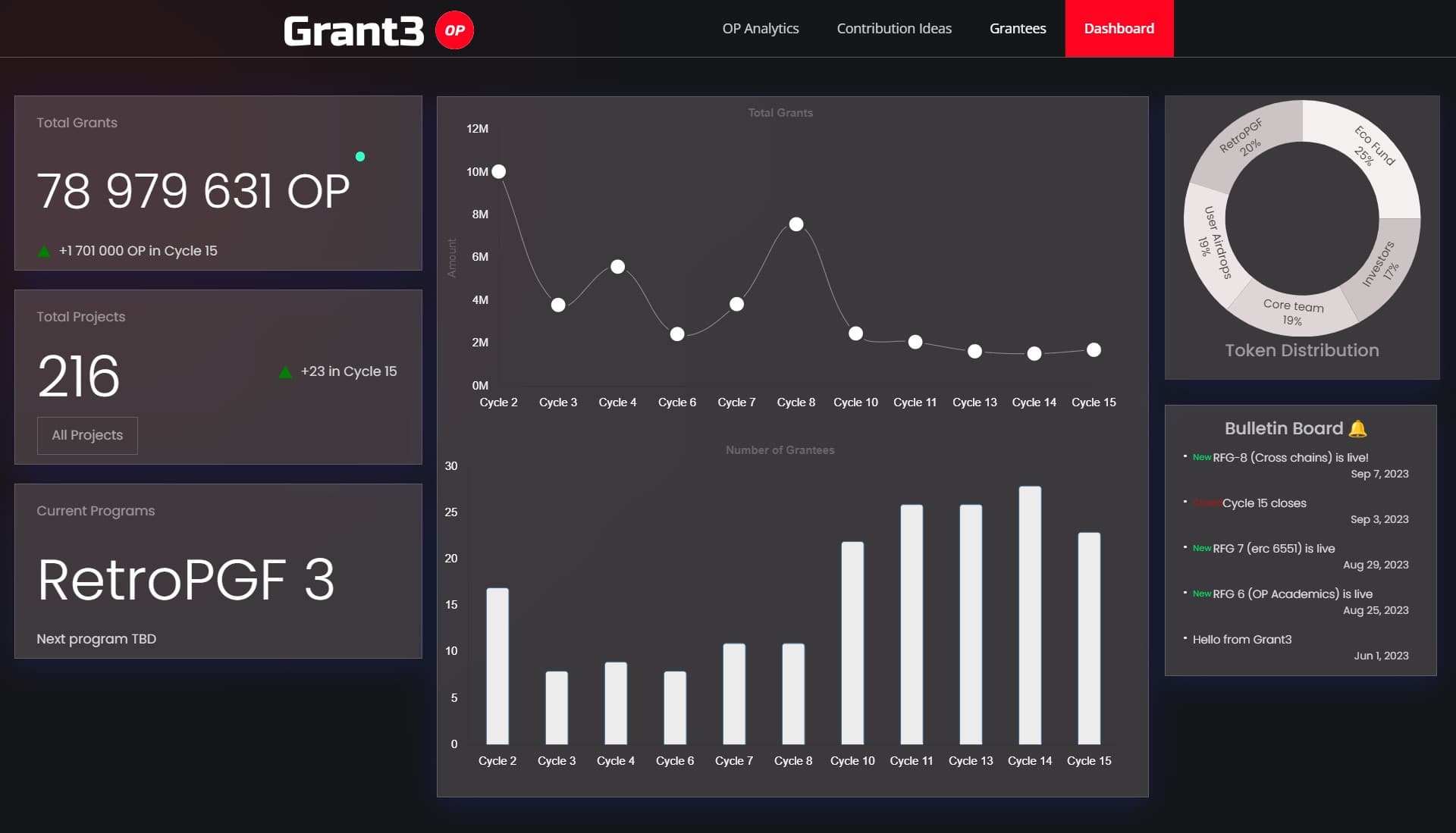
How RetroPGF Rewards Proven Builders
Optimism has moved beyond the traditional grant model of funding speculative ideas. Instead, the ecosystem relies on Retroactive Public Goods Funding (RetroPGF), a mechanism that rewards contributors only after their impact is proven. This shift prioritizes real utility over pitch decks, ensuring that capital flows to infrastructure that has already demonstrated value to the network.
The scale of this commitment is significant. The third RetroPGF round allocated $40 million to recognize ecosystem contributors, a figure that underscores Optimism’s dedication to sustaining its growth 1. By tying funding to verified usage and community benefit, the protocol creates a more resilient foundation for decentralized finance and open-source development.
This approach allows the community to vote on which projects deserve support based on tangible metrics rather than marketing. It creates a feedback loop where builders focus on solving actual user problems, knowing that success will be rewarded by the collective governance of the ecosystem.
| Feature | Traditional Grants | RetroPGF |
|---|---|---|
| Timing | Upfront | After impact |
| Evaluation | Proposal-based | Usage-based |
| Risk | High (project may fail) | Lower (proven utility) |
The transition to this model has forced projects to build with longevity in mind. Rather than chasing short-term trends, developers are incentivized to create sustainable infrastructure that serves the broader Ethereum ecosystem. This strategy not only stabilizes the Optimism network but also strengthens the entire decentralized web by rewarding those who build the tools others rely on.
Identifying infrastructure blind spots
The 2026 infrastructure strategy starts with a hard look at where the Optimism Grants Program has left gaps. While the Superchain has seen explosive growth in consumer-facing DeFi, the foundational plumbing often lags behind. The goal is to move beyond simple funding distribution and toward a targeted audit of ecosystem health.
OP Labs uses Dune Analytics to track grant effectiveness, turning raw data into strategic direction. By analyzing past allocations, the foundation can pinpoint verticals that are under-supported. This transparency allows them to correct course before a bottleneck becomes a systemic risk. The focus is shifting from broad outreach to precise infrastructure reinforcement.
Callout: Tracking these blind spots requires real-time data. Tools like Dune Analytics provide the transparency needed to evaluate grant impact and identify where capital is most needed.
The 2026 plan aims to fill these gaps by prioritizing sectors that lack robust tooling or liquidity depth. This isn't about funding every new project; it's about strengthening the rails that keep the Superchain running. By addressing these under-allocated areas, the strategy ensures that the ecosystem's growth is built on a solid, well-funded foundation.
No comments yet. Be the first to share your thoughts!